

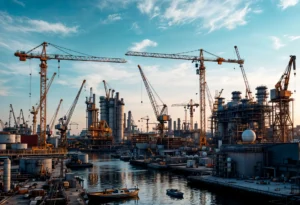
How EPC Contracts Can Save Time and Money in Industrial Projects
Industrial construction projects are rarely simple. They involve multiple stakeholders, tight timelines, complex engineering, and significant financial risk. Yet many projects still struggle with cost overruns, coordination issues, and delays—often because of fragmented responsibility.
This is where EPC contracts have become increasingly popular in industrial development.
EPC (Engineering, Procurement, and Construction) contracts are designed to simplify execution, reduce risk, and improve cost and time certainty. In this article, we explain how EPC contracts actually save time and money, and why they are well-suited for industrial projects such as factories, warehouses, processing plants, and infrastructure facilities.
What Is an EPC Contract?
An EPC contract is a project delivery model where a single contractor is responsible for:
Engineering
Design, technical drawings, approvals
Procurement
Sourcing materials, equipment, and systems
Construction
Execution, installation, testing, and commissioning
The client receives a fully functional facility, typically on a lump-sum or fixed-price basis.
In simple terms, the client deals with one accountable entity instead of coordinating multiple consultants and contractors.
Why Industrial Projects Benefit Most from EPC
- Industrial projects demand:
- High technical coordination
- Strict safety and quality standards
- Precise scheduling
- Minimal downtime
Traditional construction models often split responsibility across designers, contractors, and suppliers—creating gaps where time and money are lost.
EPC contracts address this fragmentation directly.
How EPC Contracts Save Time
01. Single-Point Responsibility Eliminates Delays
Under EPC, one contractor owns the entire delivery process. There is no ambiguity about who is responsible if something goes wrong.
- Without EPC:
- Designer blames contractor
- Contractor blames supplier
- Client manages disputes
- With EPC:
- One party resolves issues internally
- Faster decision-making
- Fewer disputes and stoppages
Time saved: Less coordination overhead, fewer work stoppages.
02. Parallel Execution of Activities
EPC projects allow engineering, procurement, and construction activities to overlap, rather than occur sequentially.
| Traditional Model | EPC Model |
|---|---|
| Design → Tender → Build | Design + procurement + construction run in parallel |
| Long idle periods | Continuous progress |
| High schedule risk | Optimised timelines |
Example:
While foundation work is ongoing, structural steel fabrication and equipment procurement can already be underway – compressing the overall schedule.
03. Faster Procurement Through Centralised Control
- EPC contractors often have:
- Established supplier networks
- Bulk purchasing power
- Pre-qualified vendors
This enables faster procurement and avoids delays caused by fragmented purchasing decisions.
Result:
Materials and equipment arrive on site exactly when needed—no early stockpiling, no last-minute shortages.
How EPC Contracts Save Money
04. Early Cost Certainty
One of the biggest financial advantages of EPC is early cost clarity.
- Most EPC contracts are:
- Lump-sum
- Fixed-price
- Or cost-plus with guaranteed maximum price
This gives clients a clear understanding of total project cost at an early stage.
Budget predictability is especially valuable for industrial investors and finance-driven projects.
05. Reduced Change Orders and Variations
In traditional models, design gaps often result in variations during construction—each adding time and cost.
- EPC contracts reduce this risk by:
- Integrating design and execution
- Conducting constructability reviews early
- Aligning engineering decisions with procurement realities
Outcome:
Fewer surprises during construction.
06. Optimised Design for Cost Efficiency
Because EPC contractors are responsible for both design and construction, they naturally design with buildability and cost in mind.
- Examples include:
- Selecting standardised structural components
- Optimising spans and layouts to reduce material usage
- Choosing equipment with lower lifecycle costs
This value engineering happens upfront—before costs escalate.
Risk Transfer: A Hidden Cost Saver
EPC contracts transfer many project risks from the client to the contractor, including:
Design errors
Procurement delays
Coordination failures
Performance shortfalls
| Risk Area | Traditional Model | EPC Model |
|---|---|---|
| Design risk | Client | Contractor |
| Schedule risk | Shared | Contractor |
| Cost overrun | Client | Contractor (to an extent) |
While EPC may appear more expensive initially, the risk reduction often results in lower total project cost.
Improved Quality and Performance Outcomes
Time and cost savings are meaningless if quality suffers. EPC contracts address this by:
- Aligning design intent with execution capability
- Using integrated QA/QC processes
- Conducting system-level commissioning
Because the EPC contractor is responsible until handover, performance issues are resolved proactively – not passed on to the client.
EPC vs Traditional Contracting: A Snapshot
| Factor | EPC Contract | Traditional Contracting |
|---|---|---|
| Coordination | Centralised | Fragmented |
| Timeline | Shorter | Longer |
| Cost Control | High | Variable |
| Client Involvement | Low | High |
| Risk Exposure | Lower | Higher |
This explains why EPC is increasingly preferred for complex industrial projects.
When EPC Makes the Most Sense
EPC contracts are particularly effective when:
- Timelines are critical
- Budget certainty is required
- Technical complexity is high
- The client has limited in-house project management resources
Industrial facilities such as factories, processing plants, warehouses, and infrastructure projects benefit the most from this model.
The Importance of Choosing the Right EPC Partner
Not all EPC contractors deliver the same value.
- Key qualities to look for include:
- Proven engineering expertise
- Strong procurement capabilities
- Experience in industrial construction
- Transparent project management systems
An EPC contract is only as effective as the team executing it.
Final Thoughts
EPC contracts are not just a contractual structure—they are a strategic approach to industrial project delivery. By integrating engineering, procurement, and construction under one accountable partner, EPC reduces delays, controls costs, and simplifies execution.
For industrial projects where time, money, and performance matter, EPC contracts offer a clear advantage over fragmented delivery models.
At Advantis Engineering, EPC and turnkey solutions are approached with a focus on engineering integrity, constructability, and long-term value—ensuring projects are delivered efficiently, responsibly, and with confidence.



Ready to make your next building sustainable?
Let’s talk about how Advantis can help you incorporate green practices without sacrificing cost or timeline.